Why Corporate Volunteering Is Becoming a Core HR Strategy in 2026: The Shift From Perks to Purpose
Not long ago, corporate volunteering sat comfortably in the "nice to have" category: a CSR checkbox, a feel-good Friday, maybe a team photo at a local food bank. HR leaders knew it mattered, but it rarely made it into a serious conversation about talent strategy.
That's changed. In 2026, forward-thinking HR teams are moving volunteering from the periphery of employee benefits to the center of their engagement and retention playbook. The reason is straightforward: employees (particularly younger ones) want to work somewhere that stands for something. A ping-pong table and a competitive salary aren't enough anymore. People want purpose, and volunteering programs, done right, deliver exactly that.
What Is Corporate Volunteering Today?
Corporate volunteering has grown far beyond its traditional one-day, show-up-and-sort-donations format. Today, it encompasses a wide spectrum of structured programs: skilled volunteering, virtual engagement, in-office activities, global campaigns, and cause-aligned team events. Companies can now run coordinated volunteering across dozens of countries, in hybrid and remote contexts, and tie it directly to business values and ESG commitments.
The shift is less about what companies are doing and more about how strategically they're doing it.
Why Traditional Employee Engagement Strategies Are Falling Short
HR leaders are operating in a tough environment. Engagement scores have plateaued or declined across industries. Quiet quitting became a cultural conversation for a reason. And the tools that HR has traditionally relied on, including annual surveys, manager training, and recognition programs, aren't moving the needle the way they once did.
The problem isn't effort. It's a connection. Employees want to feel that their work contributes to something larger. According to research, around 70% of employees prefer working for companies that care about their societal impact and support workplace giving and volunteering. Yet the gap between what employees want and what companies offer remains surprisingly wide: less than half of US companies currently offer community volunteer programs as a formal benefit.
Traditional engagement strategies often optimize for satisfaction rather than meaning. Volunteering addresses a different layer: it gives employees an emotional stake in the company's values. That's harder to replicate with a survey or a one-on-one.
How Corporate Volunteering Drives Workplace Engagement
The data here is hard to ignore.
Goodera's Global Corporate Volunteering Quotient (VQ) Report 2026, which analyzed data from 240 companies worldwide, found that median workforce participation in volunteering reached 25.6% in 2026. Among companies that consistently tracked their programs over the three-year period from 2024 to 2026, participation grew from 22.0% to 28.6%, representing a CAGR of 19.7%. These aren't vanity metrics. They reflect real organizational momentum.
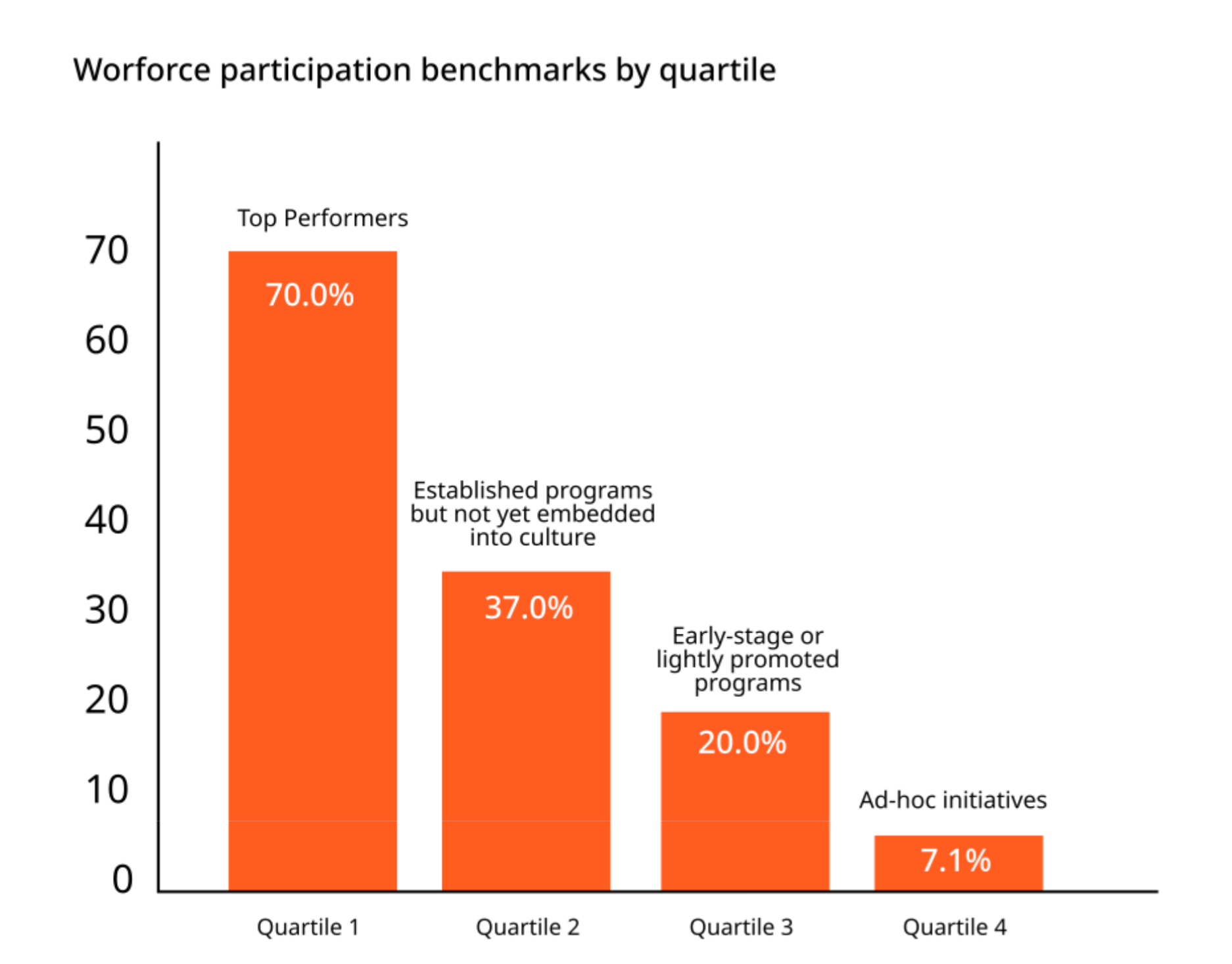
And the engagement payoff is tangible. Employees at companies with volunteer programs are reportedly five times more engaged than those at companies without them. Volunteering builds something that most engagement tactics miss: emotional connection to colleagues, to community, and to the company's stated values. When people work toward a shared purpose outside the usual context of their job, they collaborate differently, trust each other more, and return to work with renewed energy.
There's also a skills dimension that HR leaders are increasingly paying attention to. Deloitte research found that 92% of respondents believe volunteering improves an employee's skill set. For L&D teams thinking about development beyond formal training, this is a significant finding. Volunteering can build leadership, communication, and cross-functional collaboration in ways that classroom training rarely replicates.
The retention impact is notable, too. Companies with well-established volunteer programs consistently report lower turnover and higher satisfaction scores, both of which translate directly into reduced hiring costs and stronger team stability.
How Corporate Volunteering Is Evolving Globally
One of the more striking trends from the VQ Report 2026 is how participation varies and what drives the gap.
The Financial Services sector led all industries with a median participation rate of 36.4%, followed by Healthcare (28.7%) and Technology (27.6%). Smaller organizations (under 5,000 employees) recorded even higher rates, hitting 48% participation, a reminder that culture and scale interact in interesting ways, and that agility often outperforms size.
Geographically, companies are also recognizing that volunteering can no longer be a headquarters-first initiative. As workforces span continents, global volunteering infrastructure matters. Employees in India, the UK, Australia, and beyond expect locally relevant opportunities with the same organizational support as their counterparts in the US. Programs built on scalable platforms are far better positioned to deliver on that expectation than ad hoc coordination.
There's also growing alignment between volunteering programs and ESG reporting. As regulatory and investor pressure around social impact disclosures increases, volunteer data (hours contributed, causes supported, communities reached) is becoming a meaningful part of the ESG story HR and sustainability teams tell together.
How Corporate Volunteering Strengthens Employer Branding
Today's candidates evaluate employers through a much broader lens than compensation and benefits alone. They want to understand what a company stands for, how it treats its people, and whether its values show up in meaningful ways. Corporate volunteering helps answer those questions with actions rather than statements.
For many organizations, employer branding has traditionally relied on culture videos, career pages, employee testimonials, and workplace awards. While those assets still matter, candidates increasingly look for evidence that a company's values are reflected in everyday employee experiences. Volunteering creates visible proof. When employees mentor students, support local nonprofits, participate in environmental initiatives, or contribute their professional skills to community organizations, they become ambassadors for the company's culture and purpose.
This is particularly important for younger generations entering the workforce. Research consistently shows that Millennials and Gen Z employees want to work for organizations that contribute positively to society. Purpose is no longer viewed as separate from work; it is becoming part of how employees evaluate career opportunities. Companies that offer meaningful volunteering opportunities can therefore differentiate themselves in a crowded talent market.
The branding impact extends beyond recruitment. Employees who participate in volunteering programs often become some of a company's strongest advocates. They share experiences on social media, discuss volunteer initiatives with peers, and contribute authentic stories that resonate far more than corporate marketing messages. A photo from a volunteer event, a reflection on mentoring a student, or a story about supporting a local cause carries a level of credibility that traditional employer branding campaigns struggle to replicate.
Corporate volunteering also helps organizations build stronger reputations within the communities where they operate. As companies expand globally, local engagement becomes increasingly important. Employees want to see their employer making a positive contribution not only at headquarters but also in the communities where they live and work. Well-designed volunteering programs help create those connections while strengthening relationships with nonprofit partners, educational institutions, and community organizations.
Another emerging trend is the growing overlap between employer branding and ESG performance. Investors, customers, employees, and candidates are all paying closer attention to corporate social impact. Volunteer participation rates, community engagement metrics, and employee-driven impact initiatives increasingly contribute to the broader story organizations tell about their values and responsibilities. What was once considered a CSR activity is now becoming part of the overall corporate reputation strategy.
The organizations seeing the strongest results understand that volunteering is not simply a recruitment tool. It is a culture-building mechanism that influences how employees experience the company and how outsiders perceive it. When employees genuinely believe in their organization's purpose and have opportunities to act on that purpose, they become more engaged, more loyal, and more likely to recommend the company to others.
In that sense, corporate volunteering strengthens employer branding from the inside out. Rather than creating a polished image and hoping employees embrace it, organizations create meaningful experiences first. The reputation follows naturally.
How HR Teams Can Build a Scalable Volunteering Strategy
Moving from occasional volunteering to a genuine HR strategy requires more than enthusiasm. Here's what separates programs that sustain momentum from those that fizzle after the first quarter:
1. Treat it as a program, not an event: One-off days are fine, but they don't build culture. High-performing companies run year-round volunteering calendars with milestone campaigns (Earth Month, Mental Health Month, Season of Giving) layered on top. Consistency signals genuine commitment.
2. Enable, don't mandate: The VQ Report 2026 reinforces a consistent finding: companies that offer volunteering enablers, including dedicated Volunteer Time Off (VTO), "Dollars for Doers" matching grants, and access to a volunteering platform, see participation rates approximately 1.5x higher than those that don't. Removing friction matters as much as building enthusiasm.
3. Offer choice and flexibility: The modern workforce is distributed and diverse. Programs need to reflect that. A mix of virtual, in-office, in-person, and outdoor formats across cause areas that resonate with different employee communities keeps participation broad rather than concentrated among the most committed few.
4. Measure and communicate impact: Volunteering without reporting is volunteering without resonance. Employees want to know what their time achieved. Hour tracking, impact summaries, and storytelling (whether through internal comms or social feeds) close the loop and reinforce the program's value. Companies using social engagement tools to connect employees to impact work see approximately a 50% increase in volunteer hours.
5. Align with company values and ERGs: The most effective programs aren't siloed in CSR. They connect to ERG priorities, DEI goals, and leadership values. When volunteering reflects who the company says it is, employees feel the coherence, and participation follows.
Closing Thoughts
The evidence points in the same direction: corporate volunteering has evolved into one of the most effective ways to strengthen both workplace culture and business performance. From higher employee engagement and retention to stronger skill development and ESG outcomes, the benefits are increasingly measurable. Organizations that embed volunteering into their broader people and impact strategies are consistently outperforming those that approach it as an occasional activity.
For HR and social impact leaders, volunteering offers a rare opportunity to deliver value on multiple fronts. Employees actively seek opportunities to make a difference, organizations gain a powerful tool for building connection and purpose, and communities benefit from meaningful support. In a workplace where attracting, engaging, and retaining talent remains a top priority, corporate volunteering stands out as an investment that creates lasting value for employees, businesses, and society alike.

 Ei Thinzar Bo